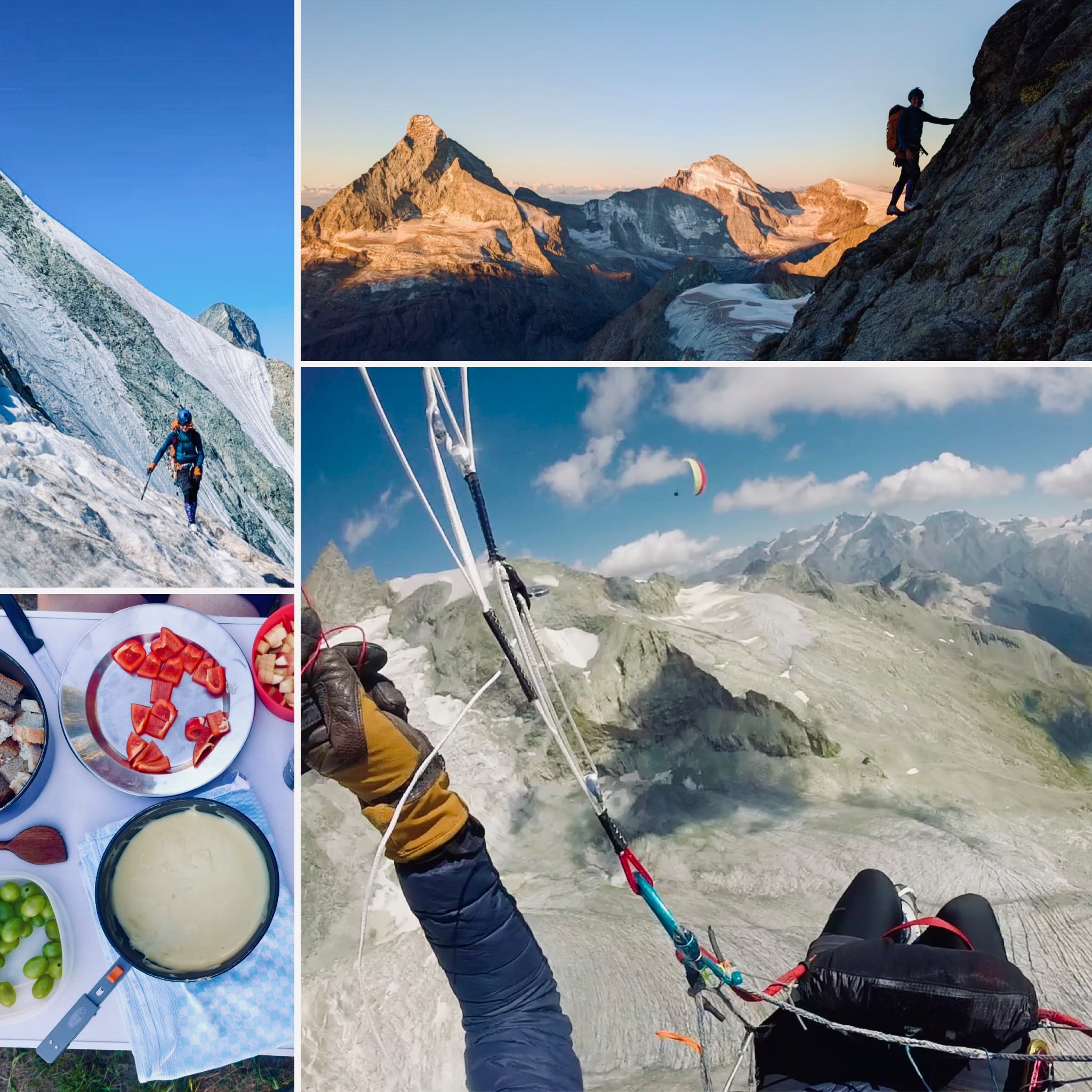
Climbing a 4,000-meter peak in Switzerland and flying back down to the valley on a Miniwing - UP team pilot Franziska Vogel did just that in gorgeous weather. Here’s her report.
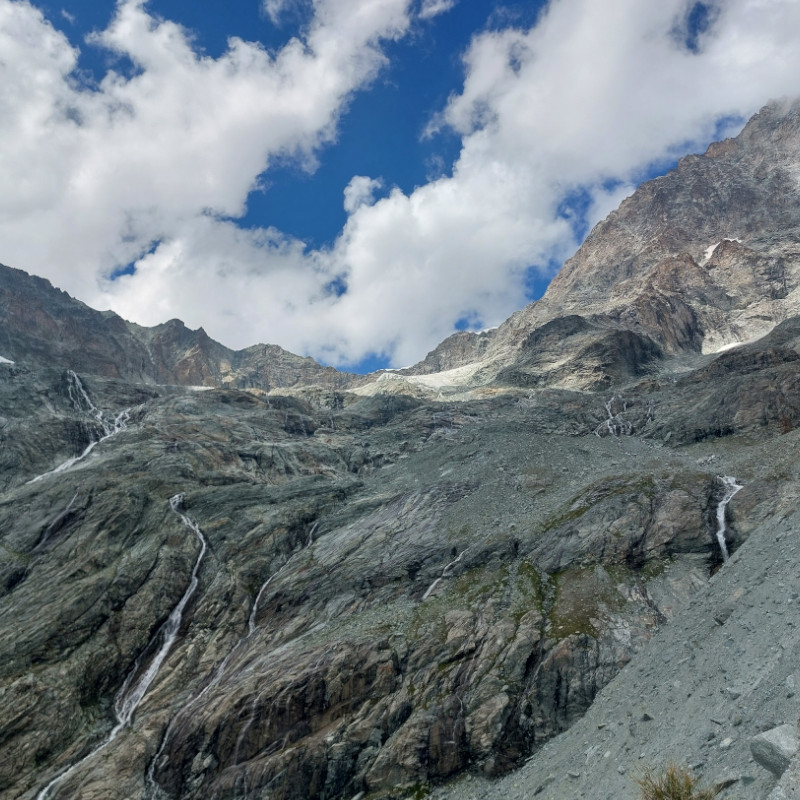
"August 2026 – We’re traveling through Switzerland in our camper for two weeks. Amid days of thunderstorms, a window of more stable weather opens up. Our friends suggest the Obergabelhorn south face - a grade IV climb up a 4,000-meter peak directly across from the Matterhorn. At first glance at the map, an idea pops into my head - one that would soon become reality. Couldn’t we launch from the Wellenkuppe on the way down? The weather forecast three days in advance looks like it’ll have perfect launch winds - that gives us hope! Even if we can’t fly, we want to go on this amazing climbing trip with our friends.
A final weather check on the morning of the approach: looks great - so a KAILASH 16 and 19 go into the backpack. Climbing gear, food for two days, a rescue, harness, and paraglider fit easily into a 35-liter backpack. In the sweltering heat, we ascend from Zermatt to the Arben Bivouac. After the grueling climb to the quaint little self-catering hut, we can hardly believe our eyes - a paragliding backpack! A Swiss mountain guide and his guest are following a similar plan. Instead of taking the south face, however, they’re choosing the slightly easier Arben Ridge as their route to the summit of the Obergabelhorn, which will likely get them to the potential launch site at least an hour earlier.
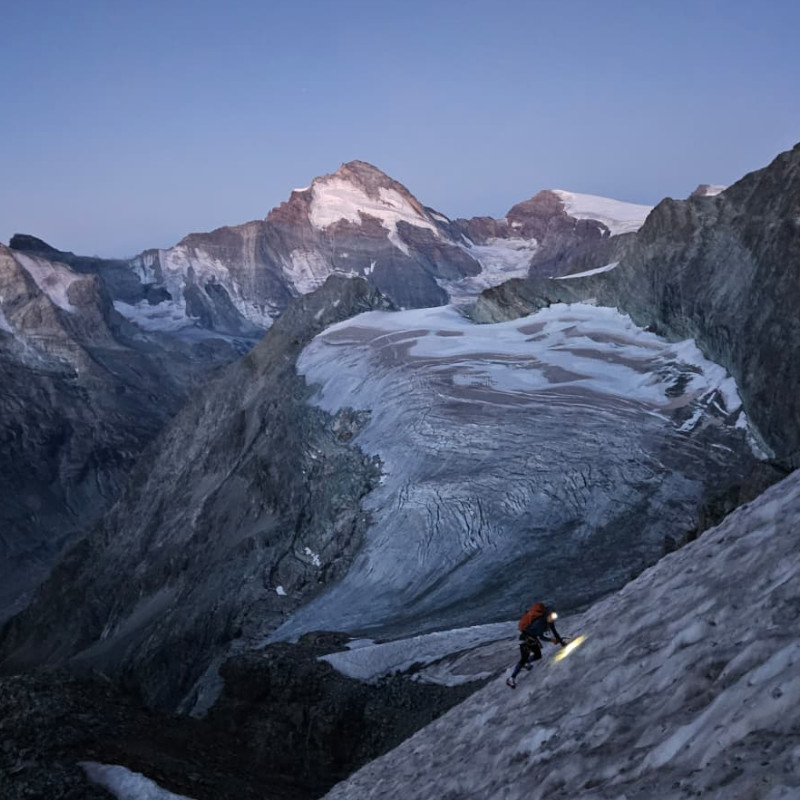
A surprisingly restful night (with no snorers!) comes to an abrupt end at 3:30 a.m. due to the headlamp light and gas stove of a rope team. We had actually planned to get up half an hour later, but oh well… At 4:30 a.m., we set off half-asleep - and are fully awake by the time we reach the steep, hard-frozen firn field before the start of the wall. With the utmost concentration, we traverse this section. From now on, every step is vertical. On mostly solid climbing terrain, we make faster progress than the climbing guidebook had anticipated. So by 9:30 a.m., we’re already standing on the summit, enjoying the breathtaking view of the Dent d’Hérens, the Matterhorn, the Dent Blanche, the Zinalrothorn, and the Monte Rosa massif. We’ve climbed several peaks here in recent years, which unfortunately allows us to draw some sad comparisons regarding the state of the glaciers.
Anton and I grin at each other: there’s almost no wind - just a light breeze blowing from the northwest. The other two pilots are already taking off from the Wellenkuppe. Perfect! All that’s left is the descent over a rocky ridge and the climb back up to the Wellenkuppe. Moving swiftly yet with full concentration, we rappel down, scramble over granite boulders, and finally ascend to the Wellenkuppe, crampons on our feet, over the hard glacier ridge to the summit.
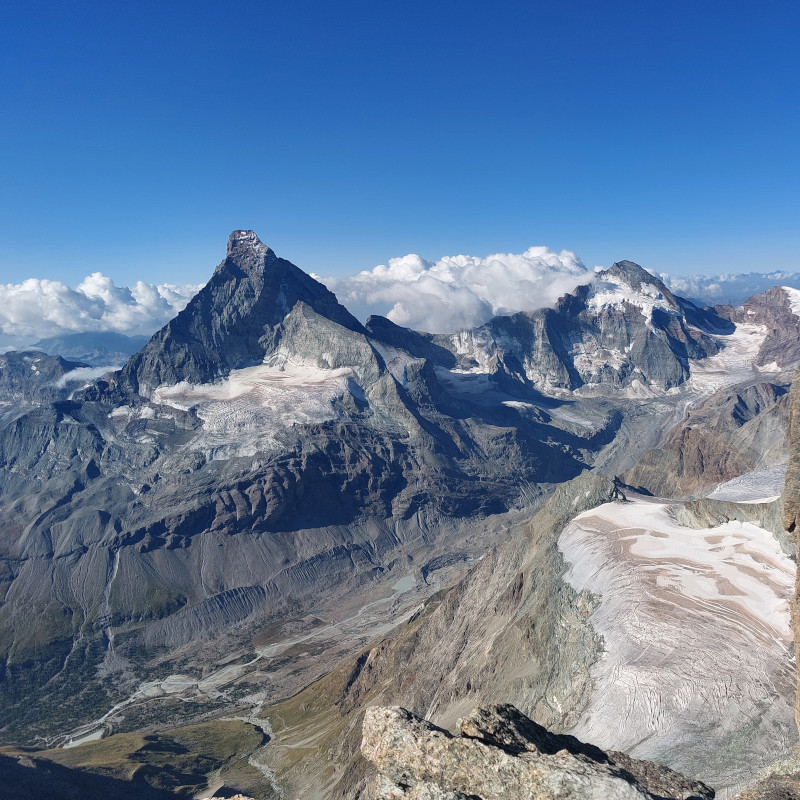
We don’t have to think twice - the wind is just right. We at least take a little ballast off our two friends before they continue their descent and we get ready to launch. Before we finally inflate the canopies of our small paragliders, there’s still one important phone call to make. To avoid the strong valley wind and the challenging landing meadows in Zermatt, we’d like to land in Täsch. On the flight path there, however, we have to fly through the airspace of the Air Zermatt heliport. We receive clearance for this over the phone without any complications. A few moments later, we hear the fluttering of rotor blades - a sightseeing helicopter whizzes past us 150 meters away in a steep turn. So the airspace must be clear now.
We let the first thermal currents, which create a light crosswind, pass us by. Then comes a bold move. Even with little wind, the canopy fills as if by itself and sits perfectly above me. A few quick steps later, I’m gliding away. The steep glacier disappears beneath me. A right turn over the saddle, a cry of joy, and then the view of the majestic Matterhorn opens up. I prefer to keep the brakes in my hands as I fly through the thermals, but the 16 m² of fabric above me carries me gently through the air. Pure bliss! I’m just about to take off my crampons when I see Anton making the most of his extra 3 m² and actually climbing in the strong Valais thermals. In the end, I’ll wait about 30 minutes for him at the landing site because he turned his descent into a little sightseeing flight.
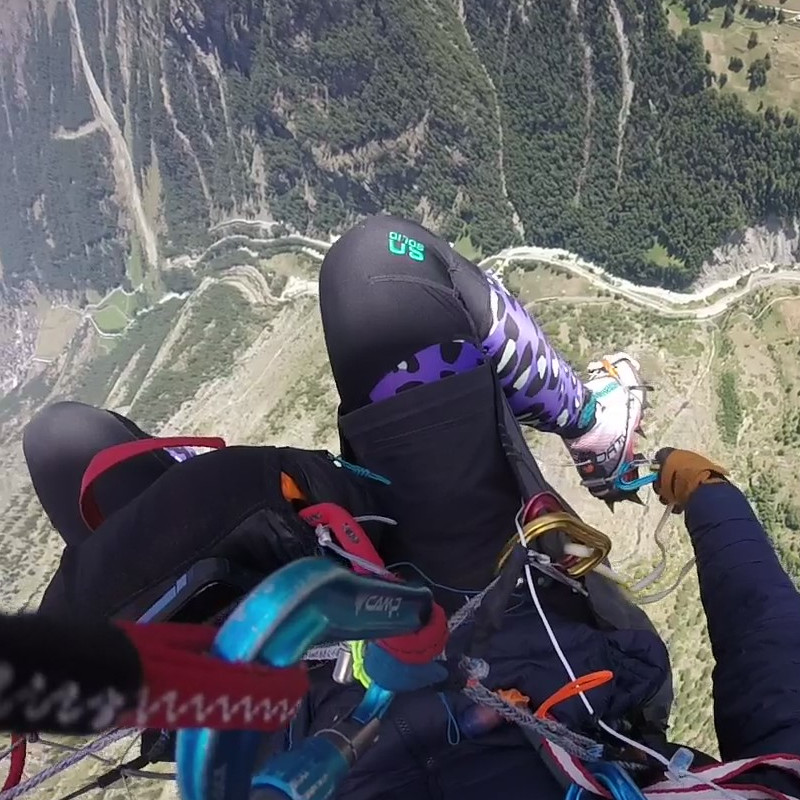
Finally, I secure the crampons to my harness with carabiners and mentally prepare for the landing. The valley wind shouldn’t be underestimated, even in Täsch. Thanks to the higher speed of the small wing, I touch down gently on the meadow. With a huge grin on my face, I shed my much-too-warm down jacket, pack up, and high-five Anton with a beaming smile.
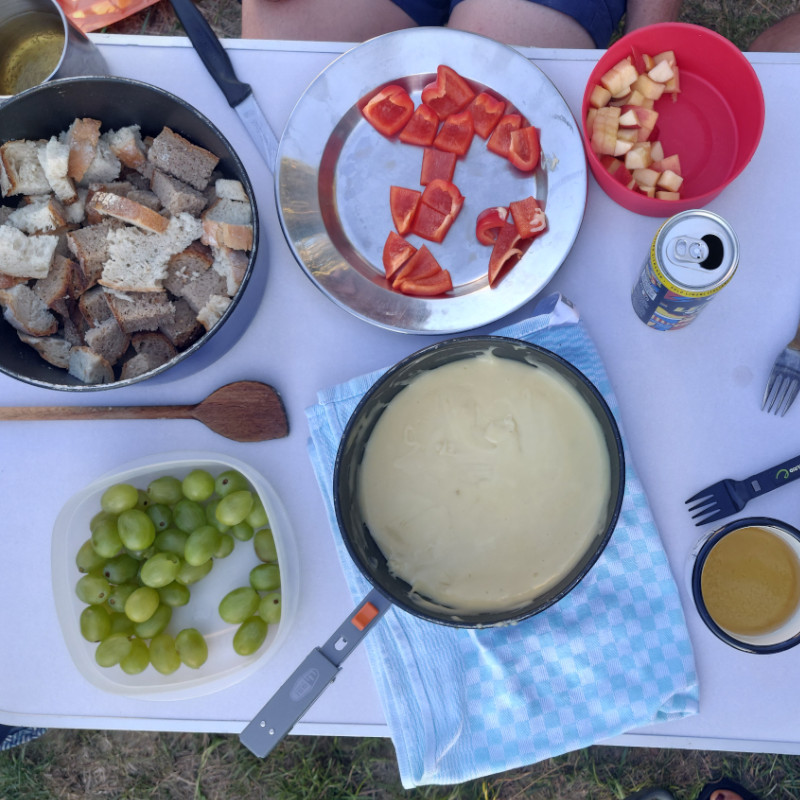
Four hours later, we greet the other two at the train station with ice-cold Italian lemonade, drive to the campground we’d booked in the meantime, and enjoy our well-deserved cheese fondue. What an amazing day!"
Tips for takeoffs in the Swiss high mountains:
- A flight is optional. The descent on foot must be planned for mentally, physically, and in terms of time.
- Switzerland has heavy air traffic from military aircraft and helicopters - check the airspace thoroughly!
- The mountains and wind systems are on a grand scale. Valley winds and thermals can become very strong.
- At higher altitudes, air pressure is lower. This requires a higher speed to take off and makes the glider’s behavior more dynamic.
- Practice in advance how to remove and secure your crampons while flying.
- Paragliders in Switzerland (including visitors) need an SHV number.
Photos: Franziska Vogel, Kai Löwenfeld, Franziska Löwenfeld